
In quantum computational chemistry, gaussian basis set is often used as wave functions of atomic orbitals.
Primitive Gaussian-Type Orbital (GTO)
One of the most basic atomic orbital is Slayter-type orbitals (STOs) like hydrogen like orbitals. However, analytical integrals of STOs are difficult. So Gaussian-type orbitals (GTOs) are often used instead of STOs. In addition, atomic orbitals are described as linear combination of primitive gaussian type orbital.
Primitive GTO is described as
where
- N is normalization constant.
- A is an atom center in cartesian coordinate.
- n, l, m are angular momentum powers (they are different from quantum number n, l, m ).
GTO is described using vector form. To clarify, GTO can be written as
Because
STO-nG
STO-nG is a basis set of immitating STO by “n primitive GTO”.
For example, in case of STO-3G which is well known basis set in quantum chemistry, atomic orbitals are described using 3 GTOs.
where
Note that normalization constants of gaussian basis sets have 2 factors.
- Primitive Normalization: The square of each GTO is needed to be 1.
Primitive normalization constant can be calculated analyticaly as
- Contracted Normalization: The square of total orbital φ(r) must be 1.
STO-3G Hydorogen 1s orbital
Let’s compare STO with STO-3G in case of Hydrogen 1s orbital. The figure is shown below.
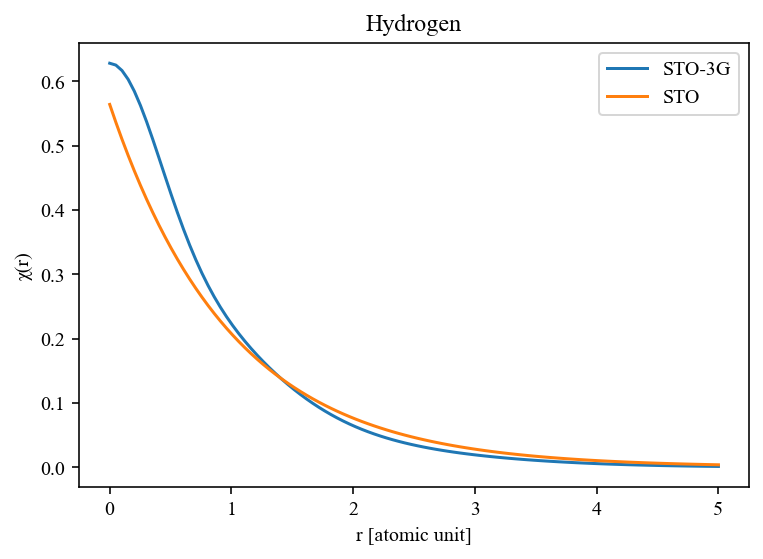
Almost all orbital shape of STO-3G is close to STO. But change of STO-3G around zero is smaller than that of STO.
Code of Drawing STO and STO-3G
I show my code drawing orbitals.
"""
Created on Sat Jul 11 23:58:53 2026

@author: kaz2255pq
"""
import numpy as np
import scipy.special
import matplotlib.pyplot as plt

def basis_set(Z,qnl):
    # STO-3G

    n = qnl[0]
    l = qnl[1]
    m = qnl[2]
    if Z == 1:
        if n == 1:
            a1 = 0.1543289673E+00
            a2 = 0.5353281423E+00
            a3 = 0.4446345422E+00

            A1 = 0.3425250914E+01
            A2 = 0.6239137298E+00
            A3 = 0.1688554040E+00

    if Z == 3:
        if n == 1:
            a1 = 0.1543289673E+00
            a2 = 0.5353281423E+00
            a3 = 0.4446345422E+00

            A1 = 0.1611957475E+02
            A2 = 0.2936200663E+01
            A3 = 0.7946504870E+00

        elif n == 2 and l == 0:
            a1 = -0.9996722919E-01
            a2 = 0.3995128261E+00
            a3 = 0.7001154689E+00

            A1 = 0.6362897469E+00
            A2 = 0.1478600533E+00
            A3 = 0.4808867840E-01

        elif n == 2 and l == 1:
            a1 = 0.1559162750E+00
            a2 = 0.6076837186E+00
            a3 = 0.3919573931E+00

            A1 = 0.6362897469E+00
            A2 = 0.1478600533E+00
            A3 = 0.4808867840E-01

    if Z == 6:
        if n == 1:
            a1 = 0.1543289673E+00
            a2 = 0.5353281423E+00
            a3 = 0.4446345422E+00

            A1 = 0.7161683735E+02
            A2 = 0.1304509632E+02
            A3 = 0.3530512160E+01
        elif n == 2 and l == 0:
            a1 = -0.9996722919E-01
            a2 = 0.3995128261E+00
            a3 = 0.7001154689E+00

            A1 = 0.2941249355E+01
            A2 = 0.6834830964E+00
            A3 = 0.2222899159E+00

        elif n == 2 and l == 1:
            a1 = 0.1559162750E+00
            a2 = 0.6076837186E+00
            a3 = 0.3919573931E+00

            A1 = 0.2941249355E+01
            A2 = 0.6834830964E+00
            A3 = 0.2222899159E+00

    if Z == 8:
        if n == 1:
            a1 = 0.1543289673E+00
            a2 = 0.5353281423E+00
            a3 = 0.4446345422E+00

            A1 = 0.1307093214E+03
            A2 = 0.2380886605E+02
            A3 = 0.6443608313E+01
        elif n == 2 and l == 0:
            a1 = -0.9996722919E-01
            a2 = 0.3995128261E+00
            a3 = 0.7001154689E+00

            A1 = 0.5033151319E+01
            A2 = 0.1169596125E+01
            A3 = 0.3803889600E+00

        elif n == 2 and l == 1:
            a1 = 0.1559162750E+00
            a2 = 0.6076837186E+00
            a3 = 0.3919573931E+00

            A1 = 0.5033151319E+01
            A2 = 0.1169596125E+01
            A3 = 0.3803889600E+00

    return np.array([a1,a2,a3,A1,A2,A3])


def angm_to_nlm(l,m):
    if l == 0:
        return (0,0,0)

    if l == 1:
        if m == -1:
            return (1,0,0) #px
        elif m == 1:
            return (0,1,0) #py
        elif m == 0:
            return (0,0,1) #pz

def fact2(n):
    if n <= 0:
        return 1
    return scipy.special.factorial2(n)

def primitive_gto(x,y,z,A,dA,aL):
    l,m,n = aL
    dx = x - A[0]
    dy = y - A[1]
    dz = z - A[2]

    r2 = dx**2 + dy**2 + dz**2
    poly = dx**l * dy**m * dz**n
    val = poly * np.exp(-dA*r2)
    #print(val.shape)
    return val

def contracted_gto(x,y,z,A,dA,coef, aL):
    val = 0
    CN = contraction_norm(coef, dA, aL,tuple(A),tuple(A))

    for beta,alpha in zip(dA,coef):
        N = primitive_norm(beta,aL)
        val += alpha  *primitive_gto(x,y,z,A,beta,aL) * N


    return val*CN

def primitive_norm(alpha,nL):
    l = nL[0]
    m = nL[1]
    n = nL[2]
    L = l+m+n

    #num = (4*alpha)**L
    num = (4*alpha)**L
    den = fact2(2*l-1)*fact2(2*m-1)*fact2(2*n-1)

    return  (2*alpha/np.pi)**0.75 * np.sqrt(num/den)

def contraction_norm(coeff, d, aL,keyA,keyB):
    S = 0.0
    A = np.zeros(3)
    for i in range(len(d)):
        for j in range(len(d)):
            Ni = primitive_norm(d[i],aL)
            Nj = primitive_norm(d[j],aL)

            Sij = overlap_os( aL,aL,A,A,d[i],d[j],keyA,keyA )

            S += ( coeff[i] * coeff[j] * Ni * Nj * Sij )

    return 1/np.sqrt(S)

def overlap_ss(aL,bL,A,B,da,db):
    gamma = da + db
    mu = da*db/gamma
    Rab2 = np.dot(A-B,A-B)
    return (np.pi/gamma)**1.5*np.exp(-mu*Rab2)

cache_ol = {}
def overlap_os(aL,bL,A,B,da,db,keyA,keyB):
    key = (
            aL,
            bL,
            keyA,
            keyB,
            da,
            db
        )

    if key in cache_ol:
        return cache_ol[key]

    if aL==(0,0,0) and bL==(0,0,0):
        val = overlap_ss(aL,bL,A,B,da,db)
        cache_ol[key] = val
        return val

    gamma = da+db
    P = (da*A + db*B)/gamma

    for i in range(3):
        if aL[i] > 0:

            a_down = list(aL)
            a_down[i] -= 1
            a_down = tuple(a_down)

            term1 = ( (P[i]-A[i]) * overlap_os(a_down,bL,A,B,da,db,keyA,keyB) )

            term2 = 0.0
            if a_down[i] >= 0:

                a_down2 = list(a_down)
                a_down2[i] -= 1

                if a_down2[i] >= 0:

                    a_down2 = tuple(a_down2)
                    term2 =  a_down[i]/(2*gamma)  * overlap_os( a_down2,bL,A,B,da,db,keyA,keyB )

            term3 = 0.0
            if bL[i] > 0:

                b_down = list(bL)
                b_down[i] -= 1
                b_down = tuple(b_down)

                term3 =  bL[i]/(2*gamma) * overlap_os( a_down,b_down,A,B,da,db,keyA,keyB )

            val = (term1 + term2 + term3)
            #if  abs(val) < 1e-8:
            #    val = 0
            cache_ol[key] = val

            return val

    for i in range(3):
        if bL[i] > 0:

            b_down = list(bL)
            b_down[i] -= 1
            b_down = tuple(b_down)

            term1 = (P[i]-B[i]) * overlap_os(aL,b_down,A,B,da,db,keyA,keyB)

            term2 = 0.0
            if b_down[i] >= 0:

                b_down2 = list(b_down)
                b_down2[i] -= 1

                if b_down2[i] >= 0:

                    b_down2 = tuple(b_down2)
                    term2 = b_down[i]/(2*gamma)* overlap_os(aL,b_down2,A,B,da,db,keyA,keyB)

            term3 = 0.0
            if aL[i] > 0:

                a_down = list(aL)
                a_down[i] -= 1
                a_down = tuple(a_down)

                term3 =  aL[i]/(2*gamma)* overlap_os(a_down,b_down,A,B,da,db,keyA,keyB)

            val = (term1 + term2 + term3)
            #if  abs(val) < 1e-8:
            #    val = 0
            cache_ol[key] = val
            return val

def sto(x,y,z,zeta,qnl):
    #zeta = Z/n
    n = qnl[0]
    l = qnl[1]
    m = qnl[2]
    r = (x**2+y**2+z**2)**0.5
    if n==1:
        orb = 1/(np.pi)**0.5*zeta**1.5*np.exp(-zeta*r)
    elif n==2 and l==0:
        orb = 1/(3*np.pi)**0.5*zeta**2.5*r*np.exp(-zeta*r)
    elif n==2 and l==1 and m==0:
        orb = 1/(np.pi)**0.5*zeta**2.5*x*np.exp(-zeta*r)
    elif n==2 and l==1 and m==-1:
        orb = 1/(np.pi)**0.5*zeta**2.5*y*np.exp(-zeta*r)
    elif n==2 and l==1 and m==1:
        orb = 1/(np.pi)**0.5*zeta**2.5*z*np.exp(-zeta*r)
    elif n==3 and l==0:
        orb = 2/3/(10*np.pi)**0.5*zeta**2.7*r**2*np.exp(-zeta*r)
    elif n==3 and l==1 and m==0:
        orb = 1/(15*np.pi)**0.5*zeta**2.7*r*x*np.exp(-zeta*r)
    elif n==3 and l==1 and m==-1:
        orb = 1/(15*np.pi)**0.5*zeta**2.7*r*y*np.exp(-zeta*r)
    elif n==3 and l==1 and m==1:
        orb = 1/(15*np.pi)**0.5*zeta**2.7*r*z*np.exp(-zeta*r)
    elif n==3 and l==2 and m==0:
        orb = 1/(6*np.pi)**0.5*zeta**2.7*(3*z**2-r**2)/(3**0.5)*np.exp(-zeta*r)
    elif n==3 and l==2 and m==-1:
        orb = 1/(6*np.pi)**0.5*zeta**2.7*(2*x*z)*np.exp(-zeta*r)
    elif n==3 and l==2 and m==1:
        orb = 1/(6*np.pi)**0.5*zeta**2.7*(2*y*z)*np.exp(-zeta*r)
    elif n==3 and l==2 and m==-2:
        orb = 1/(6*np.pi)**0.5*zeta**2.7*(x**2-y**2)*np.exp(-zeta*r)
    elif n==3 and l==2 and m==2:
        orb = 1/(6*np.pi)**0.5*zeta**2.7*(2*x*y)*np.exp(-zeta*r)

    return orb

############
### Main ###


qnl = [1,0,0]
basisA = basis_set(1,qnl)

aL = angm_to_nlm(0,0)
dA = basisA[3:]
coef = basisA[:3]
A = np.array([0,0,0])

x = np.linspace(0,5,100)
y = np.zeros(len(x))
z = np.zeros(len(x))

chi = contracted_gto(x,y,z,A,dA,coef,aL)
chi_sto = sto(x,y,z,1,qnl)

fig, ax = plt.subplots(1,1,figsize=(6,4))
plt.rcParams["font.family"] = "times new roman"

ax.set_title("Hydrogen")
ax.set_xlabel("r [atomic unit]")
ax.set_ylabel("χ(r)")
ax.plot(x,chi,label="STO-3G")
ax.plot(x,chi_sto, label ="STO")
plt.legend()
plt.show()
The basis set data included in this code were obtained from the
Basis Set Exchange (BSE).
Basis Set Exchange:
https://www.basissetexchange.org/

コメント